Post
NeuroPulse Memory Drive Review – The Future Is Now #22
Jun
NeuroPulse Memory Drive Review – The Future Is Now
For decades, cyberpunk fiction has imagined a future where human memory is no longer fragile, temporary, or entirely biological. In those dystopian neon-lit megacities, memories can be stored, copied, replayed, edited, traded, and even stolen like digital files.
The NeuroPulse Memory Drive feels like one of the most immersive and philosophically unsettling interpretations of that futuristic vision.
Combining AI-assisted neural recording systems, cognitive synchronization technology, encrypted memory architecture, biometric authentication, and sleek cyberpunk aesthetics, the NeuroPulse is designed not simply as a storage device — but as a fully integrated digital memory ecosystem capable of transforming human experience into permanent, searchable data.
After extensive fictionalized analysis inspired by neuroscience research, brain-computer interface development, digital-memory concepts, and cyberpunk neuralware design, one thing becomes immediately obvious:
The NeuroPulse Memory Drive feels like technology pulled directly from the darkest corners of a cyberpunk future.
Modern neuroscience and brain-interface research already explore technologies capable of interpreting and recording limited forms of neural activity and sensory information.
A Design That Feels More Cybernetic Than Consumer Tech
The first thing anyone notices about the NeuroPulse Memory Drive is its appearance.
Unlike conventional storage devices designed around minimalism and portability, the NeuroPulse fully embraces a futuristic cyberpunk visual identity.
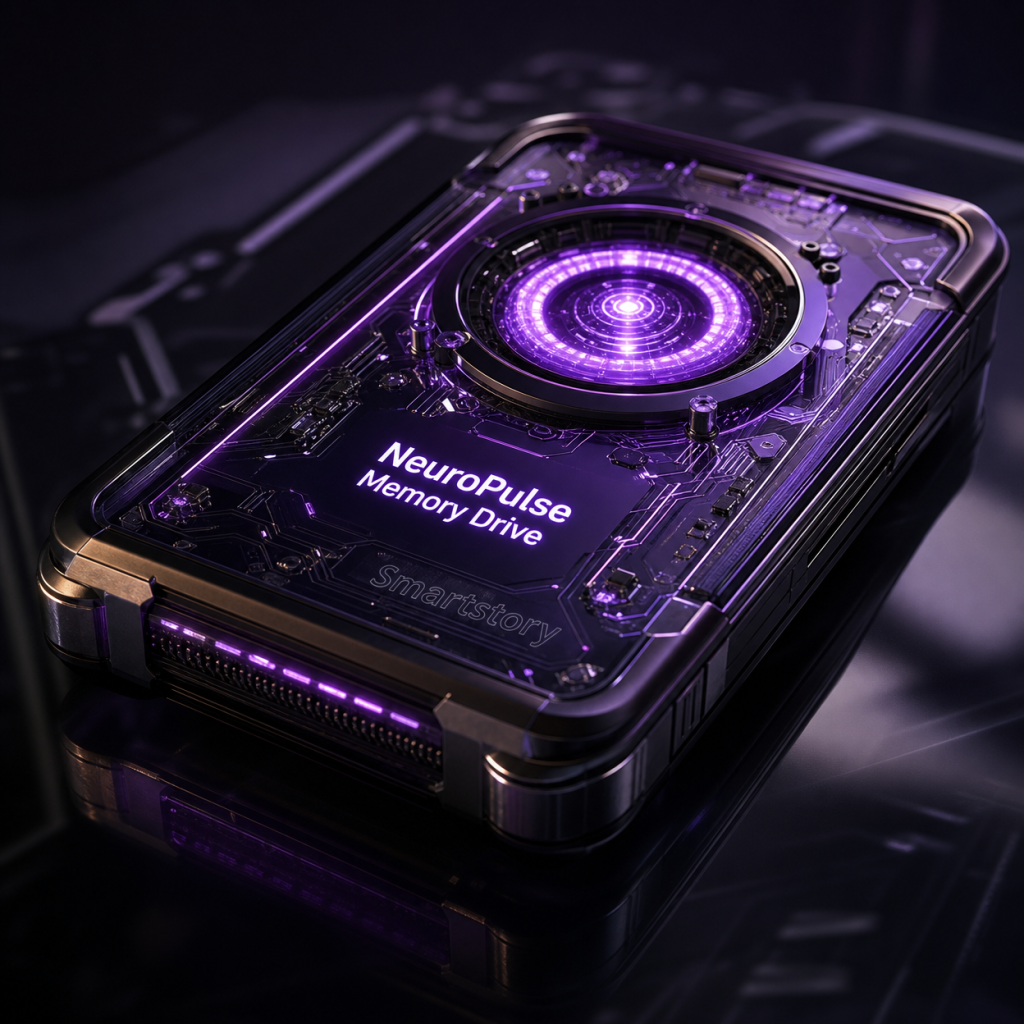
The device features a compact graphene-titanium chassis reinforced with illuminated neural conduits, biometric synchronization nodes, and a transparent quantum-memory core pulsing softly with shifting neon-blue energy patterns.
Several futuristic neural-storage concepts online already showcase similar aesthetics involving glowing data cores, cybernetic circuitry, and holographic neural interfaces.
The NeuroPulse expands those concepts into a fully immersive cognitive-storage platform.
At night, the glowing memory core reflects softly across surrounding surfaces, making the device appear less like electronics and more like experimental neural technology from a classified corporate laboratory.
Neural Memory Recording Technology
The defining feature of the NeuroPulse Memory Drive is its fictionalized neural-memory recording engine.
Instead of storing ordinary digital files, the system supposedly captures neurological activity patterns and converts sensory experiences into digitally reconstructable memory archives.
Within the fictionalized NeuroPulse ecosystem, users can supposedly record:
- Visual experiences
- Emotional responses
- Audio perception
- Spatial awareness
- Sensory impressions
- Conceptual associations
- Cognitive reactions
- Dream fragments
Modern neuroscience research increasingly explores how neural activity can represent visual and sensory information.
The NeuroPulse imagines these technologies evolving dramatically further.
Human experience itself becomes data.
The implications feel enormous.
AI-Assisted Cognitive Reconstruction
One of the most advanced aspects of the NeuroPulse Memory Drive is its integrated AI system known as NEUROPULSE Cognitive Intelligence.
Rather than functioning like ordinary file-management software, the AI continuously analyzes recorded neural data and reconstructs memories into immersive digital simulations.
The AI monitors:
- Emotional intensity
- Sensory prioritization
- Memory fragmentation
- Cognitive inconsistencies
- Environmental context
- Neurological synchronization
- Behavioral associations
- Psychological relevance
Based on this analysis, the AI generates reconstructed memory environments capable of being replayed through augmented reality systems, neural headsets, or immersive holographic interfaces.
The experience feels deeply unsettling and astonishingly futuristic.
Users no longer simply remember experiences naturally.
They replay them digitally.
Searchable Human Memory
One particularly fascinating aspect of the NeuroPulse Memory Drive is its fictionalized searchable-memory architecture.
Cyberpunk fiction has long imagined systems capable of indexing human memories like searchable databases.
Within the NeuroPulse ecosystem, users can supposedly search memories using:
- Emotional tags
- Locations
- Faces
- Time periods
- Environmental conditions
- Keywords
- Sensory impressions
- Cognitive associations
For example:
- “First snowfall memory”
- “Conversation in Neo-Tokyo district”
- “High-stress tactical encounter”
- “Childhood birthday sequence”
The AI reconstructs matching memory fragments instantly.
The result feels less like personal recollection and more like accessing a digital archive of consciousness itself.
Dream Recording and Subconscious Analysis
Perhaps the most unsettling feature of the NeuroPulse Memory Drive is its fictionalized dream-recording system.
Cyberpunk fiction frequently explores technologies capable of decoding subconscious neurological activity and transforming dreams into replayable experiences.
Within the fictionalized NeuroPulse ecosystem, the device supposedly records fragmented subconscious activity during sleep cycles and reconstructs dream environments using predictive AI interpretation.
Users can allegedly:
- Replay dreams visually
- Analyze subconscious emotional patterns
- Detect recurring psychological themes
- Archive lucid dream sequences
- Share dream simulations digitally
The implications feel extraordinary.
The subconscious mind itself becomes partially observable.
The boundary between conscious thought and machine interpretation begins to disappear.
Neural Synchronization and Biometric Security
Because the NeuroPulse directly interfaces with neurological activity, security becomes critically important.
The device includes fictionalized protections such as:
- Biometric cognition locks
- Neural-pattern encryption
- AI intrusion detection
- Memory-isolation systems
- Cognitive firewall protection
- Emotion-based authentication protocols
Cyberpunk fiction has long explored fears involving memory theft, neural hacking, and cognitive surveillance.
The NeuroPulse incorporates those fears directly into its design philosophy.
The AI continuously monitors for unauthorized cognitive access attempts and abnormal synchronization activity.
Holographic Memory Playback
One of the most visually stunning aspects of the NeuroPulse Memory Drive is its holographic memory-reconstruction interface.
Instead of displaying memories on traditional screens, the device projects immersive holographic recreations directly into the user’s environment.
The interface displays:
- Spatial memory environments
- Emotional visualization layers
- Sensory reconstruction overlays
- AI-generated contextual simulations
- Environmental memory mapping
- Neural synchronization diagnostics
The holographic playback feels cinematic and emotionally immersive.
Users do not simply watch memories.
They step inside reconstructed experiences.
Smart Ecosystem Integration
The NeuroPulse integrates deeply into futuristic neural ecosystems.
The device synchronizes with:
- Neural-interface headsets
- Augmented reality systems
- Smart-home environments
- AI cognitive assistants
- Biometric monitoring systems
- Digital identity networks
- Entertainment ecosystems
The AI continuously exchanges cognitive data across connected systems to improve reconstruction accuracy and predictive behavioral modeling.
Technology no longer behaves like external infrastructure.
It becomes part of human cognition itself.
The Cyberpunk Atmosphere
What truly makes the NeuroPulse Memory Drive compelling is the atmosphere it creates.
The glowing neural core, holographic memory playback, AI-assisted cognitive reconstruction, and searchable consciousness systems create a world where memory itself becomes commercialized digital infrastructure.
Cyberpunk fiction has always explored societies where technology penetrates the deepest layers of human identity.
The NeuroPulse embodies that philosophy perfectly.
The user no longer simply remembers experiences naturally.
Their consciousness becomes partially digitized.
Ethical and Existential Questions
Despite its extraordinary capabilities, the NeuroPulse Memory Drive raises enormous ethical concerns.
Questions quickly emerge surrounding:
- Ownership of memories
- Cognitive surveillance
- Emotional manipulation
- Memory editing
- Digital identity theft
- Psychological dependency
- Corporate control of consciousness data
- Authenticity of reconstructed experiences
Modern discussions surrounding brain-computer interfaces increasingly explore concerns involving neural privacy and cognitive autonomy.
The NeuroPulse captures the central tension of cyberpunk philosophy beautifully:
Technology offers extraordinary preservation of human experience while simultaneously threatening the boundaries of identity itself.
Final Verdict
The NeuroPulse Memory Drive represents one of the most immersive and philosophically fascinating visions of future neural-storage technology imaginable.
It successfully combines cyberpunk aesthetics, AI-assisted cognitive reconstruction, holographic memory playback, neural synchronization, dream recording, and searchable consciousness systems into a concept that feels remarkably believable.
More importantly, it reflects how rapidly modern neuroscience, brain-computer interface research, and AI-driven cognitive systems are approaching ideas once considered purely science fiction.
The NeuroPulse is not simply about storing memories digitally.
It is about transforming human consciousness itself into permanent, searchable information.
And if future neural technology continues advancing toward cognitive digitization, the cyberpunk future imagined for decades may arrive far sooner than anyone expected.
