
Post
CortexShift Thought Amplifier Review – The Future Is Now #17
Jun
CortexShift Thought Amplifier Review – The Future Is Now
For decades, cyberpunk fiction has imagined a future where human thought itself becomes upgradeable. In those neon-drenched megacities filled with neural implants, AI-enhanced citizens, and cybernetic augmentation, intelligence is no longer limited by biology alone.
Memory, focus, perception, reaction speed, creativity, and even emotional control become programmable.
The CortexShift Thought Amplifier feels like one of the most immersive and philosophically dangerous interpretations of that futuristic vision.
Combining AI-assisted neural enhancement systems, cognitive amplification technology, adaptive brainwave synchronization, biometric neural mapping, and aggressive cyberpunk aesthetics, the CortexShift is designed not simply as a wearable neural device — but as a complete cognitive-enhancement platform capable of transforming human consciousness itself.
After extensive fictionalized analysis inspired by modern brain-computer interface research, neural-stimulation experiments, cyberpunk neuralware concepts, and speculative cognitive-enhancement technology, one thing becomes immediately obvious:
The CortexShift Thought Amplifier feels like technology stolen directly from a corporate cybernetics laboratory in a dystopian future.
Cyberpunk fiction has long portrayed neuralware and cognitive implants as systems capable of amplifying human perception, reflexes, and intelligence beyond normal biological limits. (Cyberpunk Wiki)
A Design That Looks More Like Cyberware Than Consumer Technology
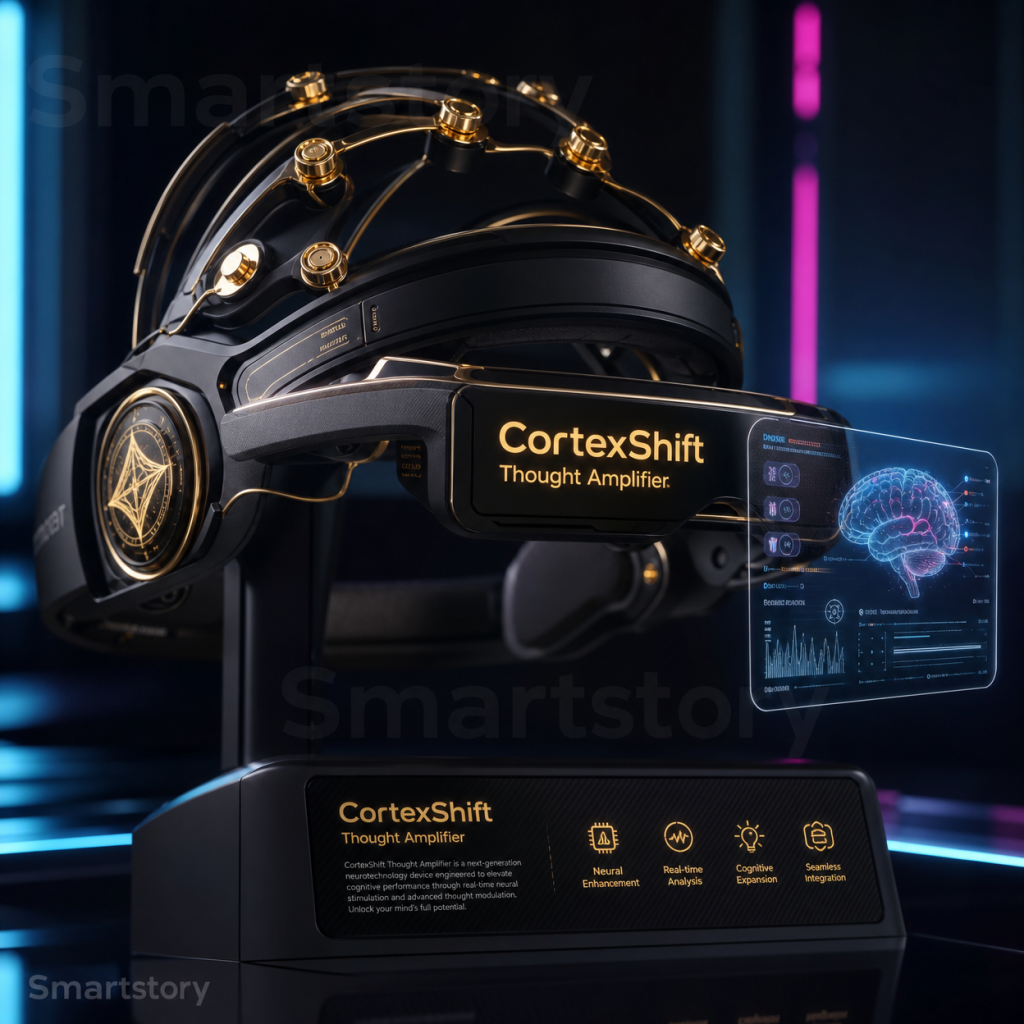
The first thing anyone notices about the CortexShift Thought Amplifier is its appearance.
Unlike ordinary wearable devices designed around minimalism and comfort, the CortexShift fully embraces a futuristic cyberpunk identity.
The headset features a matte-black graphene-alloy neural frame reinforced with illuminated bioelectric conduits, adaptive neural-contact nodes, and a transparent quantum-processing core glowing softly with shifting neon-violet energy patterns.
Several futuristic neuralware concepts online already showcase similar aesthetics involving glowing cranial implants, cybernetic neural interfaces, and AI-assisted augmentation systems. (Cyberpunk Wiki)
The CortexShift expands those ideas into a fully immersive cognitive-enhancement ecosystem.
At night, the glowing neural channels pulse dynamically according to brainwave activity, making the headset appear almost alive.
The atmosphere feels unmistakably cyberpunk.
Cognitive Amplification Technology
The defining feature of the CortexShift Thought Amplifier is its fictionalized cognitive-enhancement engine.
Instead of functioning like a traditional computer or headset, the system supposedly analyzes neural activity in real time while dynamically enhancing cognitive performance through synchronized neuroelectric stimulation and AI-assisted processing.
Modern brain-interface discussions already explore how neural stimulation and brain-computer interfaces may influence focus, cognition, and neurological interaction. (PCGamesN)
Within the fictionalized CortexShift ecosystem, users can supposedly amplify:
- Focus intensity
- Reaction speed
- Information retention
- Multitasking efficiency
- Pattern recognition
- Creative problem solving
- Emotional regulation
- Situational awareness
The result feels astonishingly futuristic.
The user no longer simply thinks naturally.
Their cognition becomes partially optimized by machine intelligence.
AI-Assisted Neural Synchronization
One of the most advanced aspects of the CortexShift Thought Amplifier is its integrated AI system known as CORTEX Adaptive Intelligence.
Rather than functioning like a normal assistant, the AI continuously analyzes neurological activity and cognitive behavior patterns in real time.
The system monitors:
- Brainwave frequency
- Emotional fluctuations
- Stress levels
- Cognitive fatigue
- Attention drift
- Memory retention efficiency
- Reaction timing
- Problem-solving behavior
Based on this analysis, the AI dynamically modifies neural stimulation patterns to maximize cognitive performance.
For example:
- During high-focus tasks, distraction filtering intensifies
- During creative sessions, associative-thinking pathways become amplified
- Under stress conditions, emotional stabilization systems activate automatically
- During tactical environments, situational-awareness processing becomes prioritized
The AI behaves less like software and more like a second cognitive layer operating alongside the user’s own mind.
This creates a deeply cyberpunk atmosphere where human consciousness and machine intelligence begin functioning as a unified system.
Thought-Responsive Interface Systems
One particularly fascinating aspect of the CortexShift is its fictionalized thought-responsive interface architecture.
Cyberpunk fiction has long imagined brain-computer interfaces capable of responding directly to cognitive intention without keyboards, touchscreens, or voice input. (tropedia.fandom.com)
Within the fictionalized CortexShift ecosystem, users can supposedly:
- Navigate digital systems mentally
- Trigger applications through neural focus
- Operate drones cognitively
- Control holographic interfaces
- Interact with AI assistants silently
- Access augmented reality systems instinctively
The experience feels remarkably immersive.
The user no longer manually operates technology.
Technology responds directly to thought patterns.
Neural Reflex Acceleration
The CortexShift becomes especially impressive during high-intensity environments.
Cyberpunk fiction frequently portrays neuralware systems capable of dramatically increasing reflex speed and perception through cognitive acceleration. (Cyberpunk Wiki)
Within the fictionalized CortexShift ecosystem, the device supposedly creates the sensation of “expanded time perception” by accelerating neurological processing speed during critical moments.
The user perceives:
- Faster situational awareness
- Enhanced environmental detail
- Improved reaction timing
- Reduced cognitive delay
- Accelerated decision-making
The atmosphere strongly resembles cyberpunk reflex-enhancement systems like “speedware” and neural combat boosters. (Cyberpunk Wiki)
The result feels exhilarating and deeply unsettling at the same time.
Holographic Cognitive Interface
One of the most visually striking aspects of the CortexShift Thought Amplifier is its holographic neural-interface system.
Instead of traditional screens, the headset projects adaptive holographic overlays directly into the user’s augmented field of vision.
The interface displays:
- Cognitive-load diagnostics
- Focus metrics
- AI-generated recommendations
- Neural synchronization levels
- Environmental analysis overlays
- Memory-assistance systems
- Predictive behavioral modeling
The holographic projections pulse dynamically according to emotional intensity and cognitive activity.
The visual identity feels remarkably cinematic and unmistakably cyberpunk.
Memory Enhancement and Learning Systems
The CortexShift also introduces fictionalized accelerated-learning systems.
Cyberpunk fiction frequently explores neuralware capable of enhancing memory retention and information processing through direct neural augmentation. (Cyberpunk Wiki)
Within the fictionalized ecosystem, users can supposedly:
- Retain information more efficiently
- Accelerate language acquisition
- Improve pattern recognition
- Replay sensory experiences
- Strengthen long-term memory encoding
- Synchronize educational systems directly with cognitive pathways
The implications feel enormous.
Learning itself becomes partially automated.
Smart Ecosystem Integration
The CortexShift integrates deeply into futuristic smart-city ecosystems.
The headset synchronizes with:
- AI assistants
- Smart-home infrastructure
- Tactical systems
- Neural communication networks
- Holographic workspaces
- Augmented reality environments
- Autonomous transportation systems
The AI continuously exchanges cognitive and environmental data across connected systems to anticipate user intent before conscious decisions fully form.
Technology no longer behaves like external infrastructure.
It becomes part of the user’s nervous system itself.
The Cyberpunk Atmosphere
What truly makes the CortexShift Thought Amplifier compelling is the atmosphere it creates.
The glowing neural circuitry, AI-assisted cognition systems, holographic overlays, and direct brain synchronization create a world where intelligence itself becomes commercially upgradeable.
Cyberpunk fiction has always explored societies where corporations monetize human enhancement and cognition becomes a battlefield of technological inequality. (PCGamesN)
The CortexShift embodies that philosophy perfectly.
The user no longer feels entirely biological.
They feel augmented.
Enhanced.
Partially machine-driven.
Ethical and Existential Questions
Despite its extraordinary capabilities, the CortexShift Thought Amplifier raises enormous ethical concerns.
Questions quickly emerge surrounding:
- Cognitive manipulation
- AI influence over thought patterns
- Neurological dependency
- Corporate ownership of neural data
- Emotional regulation through algorithms
- Cognitive inequality
- Identity fragmentation
- Loss of mental autonomy
Cyberpunk fiction has long portrayed cognitive-enhancement technology as both empowering and dangerously invasive. (Cyberpunk Wiki)
The CortexShift captures that tension beautifully.
The device offers extraordinary cognitive power while simultaneously threatening the boundaries of individuality itself.
Final Verdict
The CortexShift Thought Amplifier represents one of the most immersive and philosophically fascinating visions of future cognitive-enhancement technology imaginable.
It successfully combines cyberpunk aesthetics, AI-assisted neural synchronization, cognitive amplification systems, holographic interfaces, reflex acceleration, and thought-responsive interaction into a concept that feels remarkably believable.
More importantly, it reflects how rapidly modern brain-computer interface research, neural stimulation technology, and AI-assisted cognition systems are beginning to approach ideas once considered purely science fiction. (PCGamesN)
The CortexShift is not simply about thinking faster.
It is about transforming human consciousness itself into programmable infrastructure.
And if neural-enhancement technology continues advancing toward seamless cognitive augmentation, the cyberpunk future imagined for decades may arrive far sooner than anyone expected.
