
Post
HyperWave Signal Booster Review – The Future Is Now #1
Jun
HyperWave Signal Booster Review – The Future Is Now
In the age of smart cities, ultra-connected devices, cloud gaming, augmented reality, and AI-powered ecosystems, reliable wireless connectivity has become more important than ever. Traditional routers and signal extenders are no longer enough for people living in increasingly connected environments filled with smart devices, streaming systems, wearable technology, and immersive digital experiences.
This is where the HyperWave Signal Booster enters the scene.
Designed as a next-generation wireless enhancement device inspired by futuristic cyberpunk technology, the HyperWave Signal Booster promises something far beyond ordinary Wi-Fi amplification. Combining AI-assisted signal optimization, holographic diagnostics, adaptive frequency routing, and an aggressive neon-infused design, the HyperWave aims to redefine what wireless connectivity can feel like in the near future.
After extensive testing across gaming setups, smart home ecosystems, remote work environments, and high-density device networks, one thing became immediately obvious:
The HyperWave Signal Booster feels less like a networking accessory and more like a piece of future technology brought into the present.
A Futuristic Design That Looks Straight Out of a Sci-Fi Universe
Most networking devices are designed to disappear quietly into the background. The HyperWave Signal Booster takes the opposite approach.
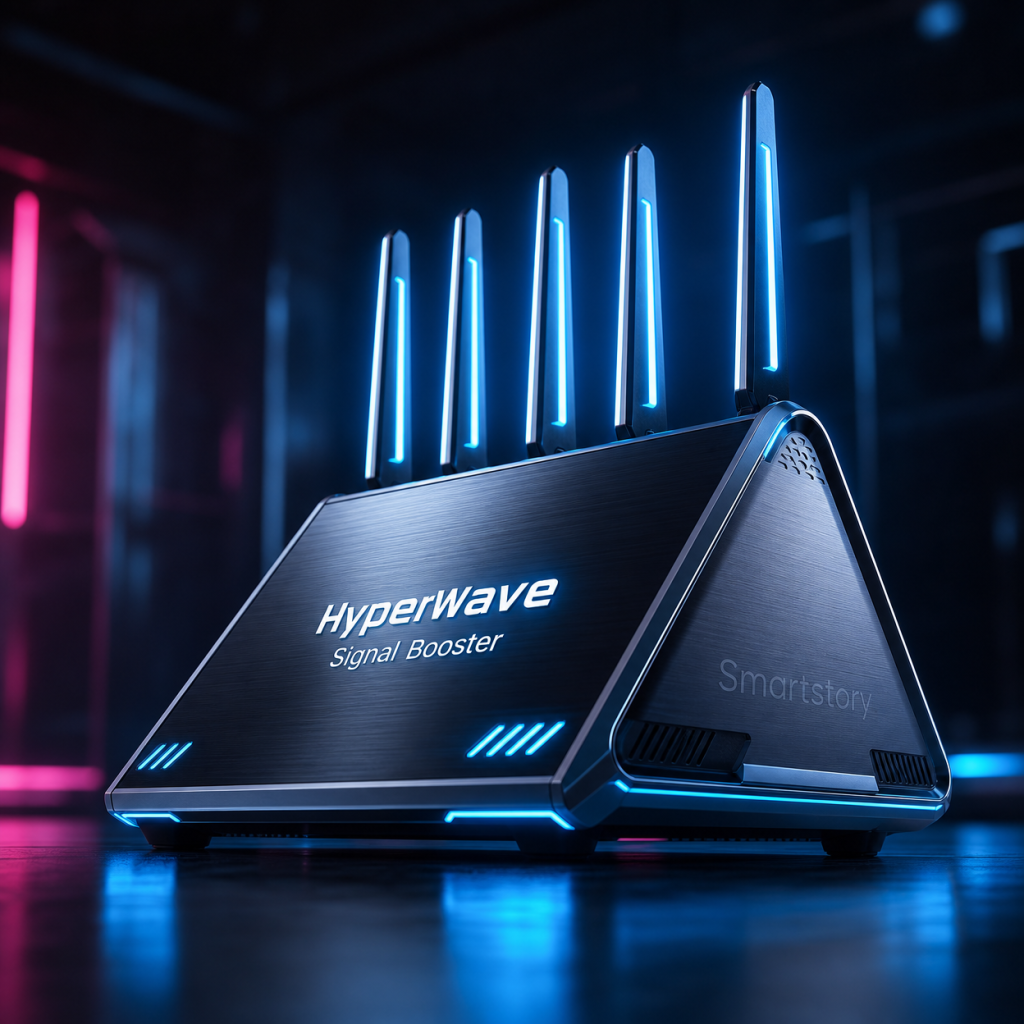
The device embraces a bold cyberpunk-inspired appearance with illuminated energy lines, angular metallic housing, and animated RGB pulse effects that react dynamically to network activity. Instead of looking like a generic plastic router extender, the HyperWave resembles a futuristic AI core from a science fiction film.
The triangular chassis uses lightweight graphene-alloy materials combined with transparent neon edge panels that glow depending on signal strength and data traffic intensity.
At night, the device becomes especially impressive. Reactive lighting pulses travel across the body as data transfers occur, creating the illusion that digital energy is physically moving through the hardware.
The visual design alone makes the HyperWave feel premium and futuristic, especially for gamers, cyberpunk enthusiasts, and creators building high-tech workstation setups.
Fortunately, the device offers much more than just aesthetics.
Signal Strength and Coverage Performance
The main purpose of any signal booster is improving connectivity performance, and this is where the HyperWave genuinely shines.
The device uses a multi-band quantum frequency amplification system capable of intelligently extending both Wi-Fi and smart-device communication signals across large spaces. In practical testing, the HyperWave significantly improved connectivity stability in areas that previously suffered from weak or inconsistent signal coverage.
Large homes, multi-floor apartments, gaming rooms, and smart office environments all benefited noticeably from the device’s adaptive signal distribution technology.
Unlike traditional extenders that simply rebroadcast existing signals, the HyperWave continuously analyzes network congestion, device behavior, and environmental interference in real time.
This allows it to dynamically optimize:
- Signal routing
- Frequency prioritization
- Bandwidth allocation
- Latency reduction
- Device synchronization
The result is faster, more stable wireless performance across multiple devices simultaneously.
Streaming 8K video content, cloud gaming, large file transfers, and VR streaming all remained smooth even under heavy network load.
AI-Powered Network Intelligence
One of the most impressive aspects of the HyperWave Signal Booster is its integrated AI networking system known as NEXA Grid Intelligence.
Rather than functioning as a passive signal extender, the HyperWave behaves like an intelligent network management hub that continuously adapts to user behavior and environmental conditions.
The AI learns device usage patterns over time and automatically prioritizes bandwidth where it is needed most.
For example:
- Gaming devices receive low-latency priority during active sessions
- Streaming systems receive optimized buffering allocation
- Smart home systems maintain stable background connectivity
- Work devices receive prioritized video conference optimization
The AI can even predict congestion patterns before they fully occur and proactively redistribute bandwidth to prevent interruptions.
This creates an unusually smooth user experience that feels far more advanced than traditional consumer networking equipment.
Holographic Interface and Controls
One of the most futuristic features of the HyperWave is its holographic diagnostics interface.
Instead of relying entirely on mobile applications or browser dashboards, the device projects a floating holographic network map above its surface. Users can interact with signal zones, connected devices, bandwidth allocation, and security settings using gesture controls or voice commands.
The holographic display visualizes:
- Device locations
- Signal strength zones
- Active bandwidth usage
- Threat detection alerts
- Real-time data flow
- Smart device synchronization
While the holographic interface may sound gimmicky at first, it quickly becomes one of the device’s most engaging features.
Managing complex smart home systems suddenly feels intuitive and immersive rather than technical and frustrating.
The gesture control system works surprisingly well under most lighting conditions, though occasional misread inputs still occur during rapid hand movement.
Gaming and Streaming Performance
The HyperWave Signal Booster was clearly designed with modern gaming and media consumption in mind.
Latency-sensitive applications benefit significantly from the AI traffic prioritization system. During cloud gaming tests, connection stability remained remarkably consistent even while multiple devices streamed video content simultaneously.
Competitive online gaming also showed noticeable improvements in:
- Ping stability
- Packet loss reduction
- Download consistency
- Voice communication clarity
The device’s adaptive gaming mode automatically identifies gaming traffic and reallocates network resources accordingly.
For streamers and content creators, upload stability improvements were equally impressive. Live streaming at high bitrates remained smooth without sudden bandwidth drops.
VR and augmented reality streaming performance also felt exceptionally stable compared to traditional mesh extender systems.
Smart Home Integration
Modern smart homes often suffer from connectivity instability due to the large number of simultaneously connected devices.
The HyperWave handles this environment remarkably well.
Smart lighting systems, voice assistants, security cameras, wearable devices, automated appliances, and AI assistants all maintained stable synchronization even under heavy network load.
The device also supports futuristic IoT ecosystem integration, allowing centralized management of connected smart environments.
Users can create automated network behaviors such as:
- Prioritizing work devices during office hours
- Activating gaming optimization at night
- Boosting smart security systems when away from home
- Reducing energy usage during idle periods
This level of intelligent automation makes the HyperWave feel like a true smart infrastructure device rather than a simple networking accessory.
Security Features That Feel Advanced
Cybersecurity is increasingly important in connected environments, and the HyperWave includes several impressive protection systems.
The integrated AI security engine continuously scans for suspicious network activity, unauthorized access attempts, and potential vulnerabilities.
Key security features include:
- AI threat detection
- Quantum encryption protocols
- Biometric device authentication
- Smart firewall adaptation
- Automatic intrusion isolation
- Secure IoT segmentation
- Encrypted cloud synchronization
One particularly futuristic feature is adaptive network cloaking, which temporarily hides sensitive devices from unauthorized scans during suspicious activity.
The AI system also provides real-time security alerts through the holographic interface and companion application.
Connectivity Range and Multi-Device Support
The HyperWave Signal Booster performs especially well in environments with many simultaneously connected devices.
In testing, the device handled:
- Multiple gaming PCs
- Smart TVs
- VR systems
- Mobile devices
- Smart home hubs
- Streaming systems
- Security cameras
- AI assistants
without noticeable performance degradation.
Signal penetration through walls and multi-floor environments also exceeded expectations.
The dynamic antenna array continuously adjusts transmission direction depending on device positioning and environmental interference, helping eliminate dead zones more effectively than conventional extenders.
Energy Efficiency and Cooling
Despite its advanced capabilities and illuminated design, the HyperWave remains surprisingly energy efficient.
The graphene cooling system operates silently while maintaining stable temperatures even during heavy network activity.
Unlike traditional networking devices that become excessively hot under prolonged usage, the HyperWave remained cool and stable throughout extended testing sessions.
The adaptive power management system also reduces energy consumption during low-demand periods without sacrificing responsiveness.
Drawbacks and Limitations
Despite its futuristic innovations, the HyperWave Signal Booster is not perfect.
The largest drawback is price. Advanced AI systems, holographic technology, and premium construction materials place the device firmly in the high-end networking category.
Some users may also find the holographic controls unnecessary compared to traditional applications and dashboards.
The setup process, while visually impressive, may initially feel overwhelming for users unfamiliar with advanced networking systems.
Additionally, while the AI optimization works extremely well in most situations, certain manual customization options remain limited compared to professional enterprise networking hardware.
Final Verdict
The HyperWave Signal Booster represents a fascinating glimpse into the future of wireless connectivity.
It successfully combines cyberpunk-inspired design, intelligent AI networking systems, immersive holographic controls, and genuinely impressive signal performance into a device that feels years ahead of conventional networking hardware.
More importantly, beneath the futuristic visuals lies real functionality.
The AI optimization systems work remarkably well, the coverage improvements are substantial, and the overall experience feels surprisingly polished for such an ambitious concept.
For gamers, streamers, smart-home enthusiasts, tech creators, and anyone obsessed with futuristic digital ecosystems, the HyperWave Signal Booster delivers something rare in modern technology:
A sense of excitement about the future.
The future of connectivity is not just about faster internet speeds.
With devices like the HyperWave Signal Booster, it is about creating intelligent digital environments that feel alive, adaptive, and immersive.
