Post
HoloGrid Portable Projector Review – The Future Is Now #21
Jun
HoloGrid Portable Projector Review – The Future Is Now
For decades, science fiction and cyberpunk fiction have imagined a future where screens disappear entirely. In those neon-lit megacities filled with holographic advertisements, AI-driven interfaces, and floating digital environments, information no longer stays trapped inside phones, monitors, or televisions.
Instead, digital content exists directly within physical space itself.
The HoloGrid Portable Projector feels like one of the most immersive and visually stunning interpretations of that futuristic vision.
Combining adaptive holographic projection technology, AI-assisted spatial rendering, gesture-controlled interfaces, volumetric display systems, neural-responsive interaction, and aggressive cyberpunk aesthetics, the HoloGrid is designed not simply as a portable projector — but as a complete holographic computing ecosystem capable of transforming any environment into an interactive digital space.
After extensive fictionalized analysis inspired by real-world holographic projection research, volumetric display systems, spatial computing, and cyberpunk interface design, one thing becomes immediately obvious:
The HoloGrid Portable Projector feels like technology pulled directly from a dystopian cyberpunk future.
Modern holographic projection systems already explore volumetric displays, laser-based projection, spatial light modulators, and floating 3D visual environments.
A Design Built for a Cyberpunk World
The first thing anyone notices about the HoloGrid Portable Projector is its appearance.
Unlike traditional projectors focused on minimalism and invisibility, the HoloGrid fully embraces a futuristic cyberpunk identity.
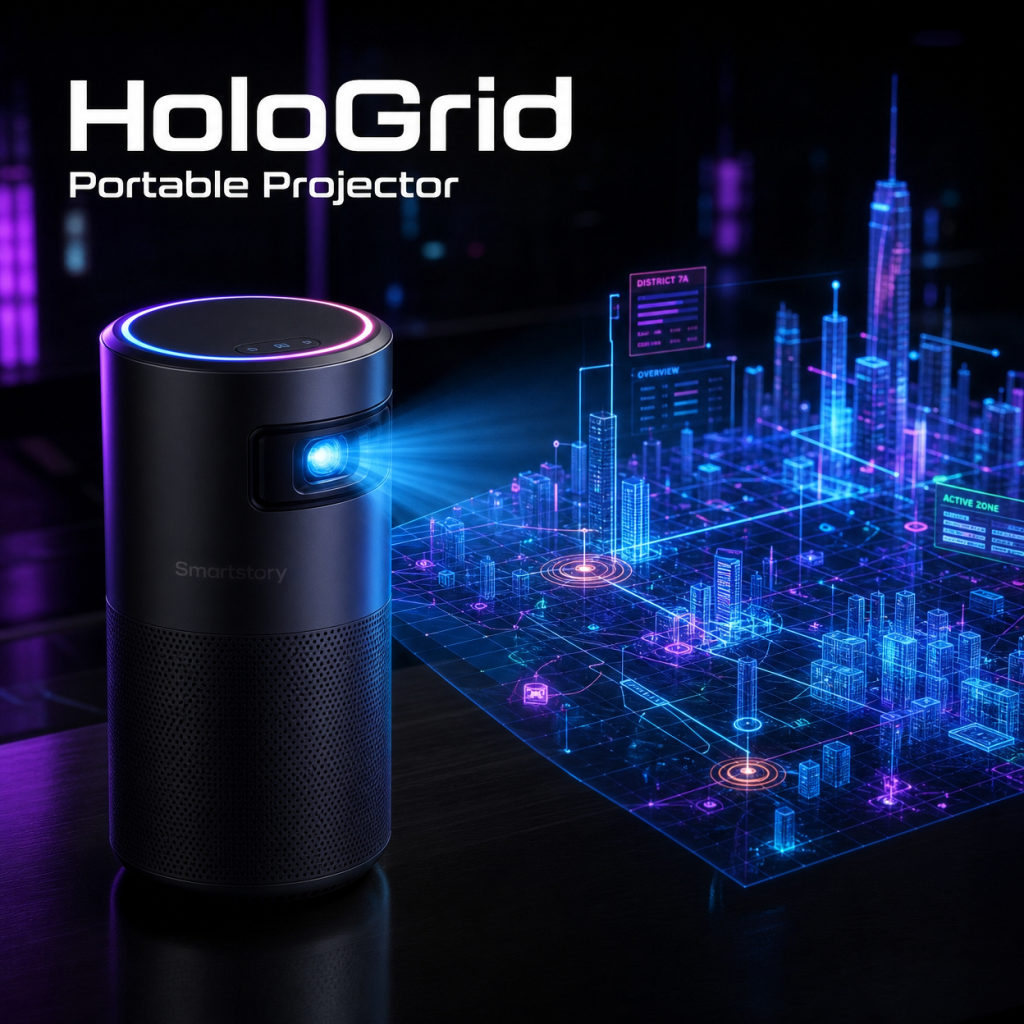
The device features a compact graphene-alloy chassis reinforced with illuminated plasma-blue circuitry, rotating projection vents, and a transparent holographic-core chamber glowing softly with shifting neon energy patterns.
Several futuristic holographic-projector concepts online already showcase similar aesthetics involving floating volumetric displays, glowing projection systems, and cyberpunk-inspired industrial design.
The HoloGrid expands those concepts into a fully immersive portable holographic ecosystem.
At night, the glowing projection core reflects across nearby surfaces while projection emitters pulse dynamically during holographic rendering.
The device feels less like consumer electronics and more like classified experimental technology stolen from a megacorporation research facility.
Adaptive Holographic Projection System
The defining feature of the HoloGrid Portable Projector is its fictionalized adaptive holographic rendering engine.
Instead of projecting images onto flat surfaces, the system supposedly creates volumetric holographic environments visible directly in open space.
Real-world holographic displays already explore volumetric imaging, laser projection systems, and spatial-light modulation technologies capable of producing floating visual effects.
Within the fictionalized HoloGrid ecosystem, users can supposedly generate:
- Floating holographic displays
- Interactive 3D interfaces
- Spatial gaming environments
- Holographic communication systems
- Virtual workspaces
- Tactical simulation overlays
- Smart-home control hubs
- AI-generated immersive environments
The result feels astonishingly futuristic.
Digital information no longer exists inside screens.
It occupies physical space itself.
AI-Assisted Spatial Rendering
One of the most advanced aspects of the HoloGrid Portable Projector is its integrated AI system known as HOLOGRID Spatial Intelligence.
Rather than functioning like ordinary projection software, the AI continuously analyzes environmental geometry and user behavior in real time.
The system monitors:
- Room dimensions
- Lighting conditions
- Surface reflectivity
- User positioning
- Gesture patterns
- Environmental obstacles
- Visual focus zones
- Interaction behavior
Based on this analysis, the AI dynamically adjusts holographic rendering for maximum immersion.
For example:
- Brightness increases automatically in daylight environments
- Projection depth adapts according to room size
- Holograms reposition dynamically as users move
- Interfaces simplify during cognitive overload
- AI assistants emerge contextually when needed
The AI behaves less like software and more like a responsive digital architect continuously rebuilding the environment around the user.
Gesture-Controlled Holographic Interfaces
One particularly fascinating aspect of the HoloGrid is its fictionalized gesture-recognition system.
Modern holographic-interface concepts increasingly explore touchless interaction using hand tracking and spatial recognition technologies.
Within the fictionalized HoloGrid ecosystem, users can supposedly:
- Manipulate holograms with hand gestures
- Resize floating windows in midair
- Rotate 3D objects physically
- Swipe holographic interfaces
- Interact with AI-generated avatars
- Control smart-home systems spatially
The interaction feels remarkably cinematic.
The user no longer taps glass screens.
They physically shape digital space itself.
The experience strongly resembles futuristic holographic interfaces seen in cyberpunk films and science-fiction games.
Portable Volumetric Display Technology
What makes the HoloGrid especially compelling is its portability.
Unlike large-scale holographic installations requiring specialized environments, the HoloGrid imagines a future where volumetric projection systems become fully mobile.
Several modern concepts already explore compact holographic display systems capable of producing immersive spatial visuals in smaller form factors.
Within the fictionalized ecosystem, the HoloGrid supposedly fits inside a small tactical carrying module while generating room-scale holographic environments within seconds.
The implications feel enormous.
Any environment can instantly transform into:
- A holographic office
- A gaming arena
- A cinematic theater
- A virtual command center
- A collaborative design studio
- An immersive educational environment
Space itself becomes programmable.
Gaming and Entertainment Applications
The HoloGrid Portable Projector feels especially revolutionary for gaming and entertainment.
Cyberpunk fiction has long portrayed holographic entertainment as one of the defining characteristics of future societies.
Within the fictionalized HoloGrid ecosystem, users can supposedly:
- Play holographic multiplayer games
- Experience room-scale virtual environments
- Interact with AI-generated holographic characters
- Watch immersive floating cinema projections
- Build augmented-reality battle arenas
The projector transforms entertainment into fully spatial experiences rather than passive screen viewing.
The atmosphere feels deeply cyberpunk.
Smart-City and Urban Integration
The HoloGrid also integrates deeply into futuristic smart-city ecosystems.
The projector synchronizes with:
- Smart-home systems
- Urban infrastructure networks
- AI assistants
- Autonomous vehicles
- Drone ecosystems
- Tactical navigation systems
- Augmented reality environments
The AI continuously exchanges spatial data across connected systems to optimize holographic rendering and environmental interaction.
Technology no longer behaves like isolated hardware.
It becomes part of the surrounding environment itself.
Holographic Communication Systems
One of the most visually stunning aspects of the HoloGrid Portable Projector is its holographic communication architecture.
Instead of conventional video calls, the device projects life-sized holographic avatars directly into physical space.
Cyberpunk fiction frequently portrays holographic communication as standard infrastructure within highly digitized societies.
Within the fictionalized HoloGrid ecosystem, users can supposedly experience:
- Immersive holographic meetings
- Spatial collaboration environments
- AI-generated assistants
- Interactive educational simulations
- Real-time tactical briefings
The experience feels cinematic and deeply futuristic.
The Reality Behind the Fiction
Interestingly, real-world holographic technology still faces major technical limitations.
Experts frequently note that most modern “holographic projectors” rely on optical illusions, reflective surfaces, volumetric displays, or projection tricks rather than true free-space holography.
However, research into dynamic holography, metasurface projectors, volumetric displays, and spatial light modulators continues advancing rapidly.
The HoloGrid imagines what these technologies might eventually become once miniaturization, AI rendering, and projection systems evolve dramatically further.
Security and Privacy Concerns
Despite its extraordinary capabilities, the HoloGrid Portable Projector raises major ethical and social concerns.
Questions quickly emerge surrounding:
- Environmental surveillance
- Visual privacy
- AI-controlled digital environments
- Holographic misinformation
- Sensory overload
- Corporate control of spatial computing
- Psychological dependency on augmented environments
Cyberpunk fiction has long explored how immersive digital systems can reshape perception and blur distinctions between reality and simulation.
The HoloGrid captures that tension perfectly.
The Cyberpunk Atmosphere
What truly makes the HoloGrid compelling is the atmosphere it creates.
The glowing projection core, floating holographic interfaces, AI-assisted spatial rendering, gesture-controlled interaction systems, and immersive volumetric displays create a world where digital information becomes part of physical reality itself.
Cyberpunk fiction has always imagined futures where cities glow with holographic advertisements, floating interfaces, and AI-generated environments.
The HoloGrid embodies that vision beautifully.
The user no longer merely watches technology.
They physically inhabit it.
Final Verdict
The HoloGrid Portable Projector represents one of the most visually immersive and technologically fascinating visions of future holographic computing imaginable.
It successfully combines cyberpunk aesthetics, volumetric projection technology, AI-assisted spatial rendering, gesture-controlled interfaces, holographic communication systems, and portable mixed-reality environments into a device that feels remarkably cinematic.
More importantly, it reflects how rapidly modern holographic-display research, volumetric rendering systems, spatial computing, and augmented reality technologies are beginning to approach ideas once considered purely science fiction.
The HoloGrid is not simply about replacing traditional screens.
It is about transforming physical space itself into an interactive digital interface.
And if holographic technology continues evolving toward seamless volumetric projection and AI-driven spatial computing, the cyberpunk future imagined for decades may arrive far sooner than anyone expected.
