
Post
NeonSight AR Glasses Review – The Future Is Now #19
Jun
NeonSight AR Glasses Review – The Future Is Now
For decades, cyberpunk fiction has imagined a future where reality itself becomes layered with digital information. In those neon-lit dystopian worlds, people no longer stare down at smartphones or computer screens. Instead, holographic interfaces float directly in front of their eyes while artificial intelligence systems seamlessly blend physical and digital environments together.
The NeonSight AR Glasses feel like one of the most immersive and visually believable interpretations of that futuristic vision.
Combining AI-assisted augmented reality systems, neural-responsive interface technology, adaptive holographic projection, biometric synchronization, and sleek cyberpunk aesthetics, the NeonSight is designed not simply as smart glasses — but as a complete wearable mixed-reality ecosystem capable of transforming how humans experience the world itself.
After extensive fictionalized analysis inspired by modern augmented reality research, smart-glasses development, spatial-computing systems, and cyberpunk visual culture, one thing becomes immediately obvious:
The NeonSight AR Glasses feel like the first true eyewear from a cyberpunk future.
Modern AR systems already explore wearable displays capable of overlaying digital information directly into the user’s field of vision. (microsoft.com)
A Design Straight Out of a Cyberpunk Megacity
The first thing anyone notices about the NeonSight AR Glasses is their appearance.
Unlike conventional smart glasses focused on minimalism and corporate simplicity, the NeonSight fully embraces an aggressive cyberpunk visual identity.
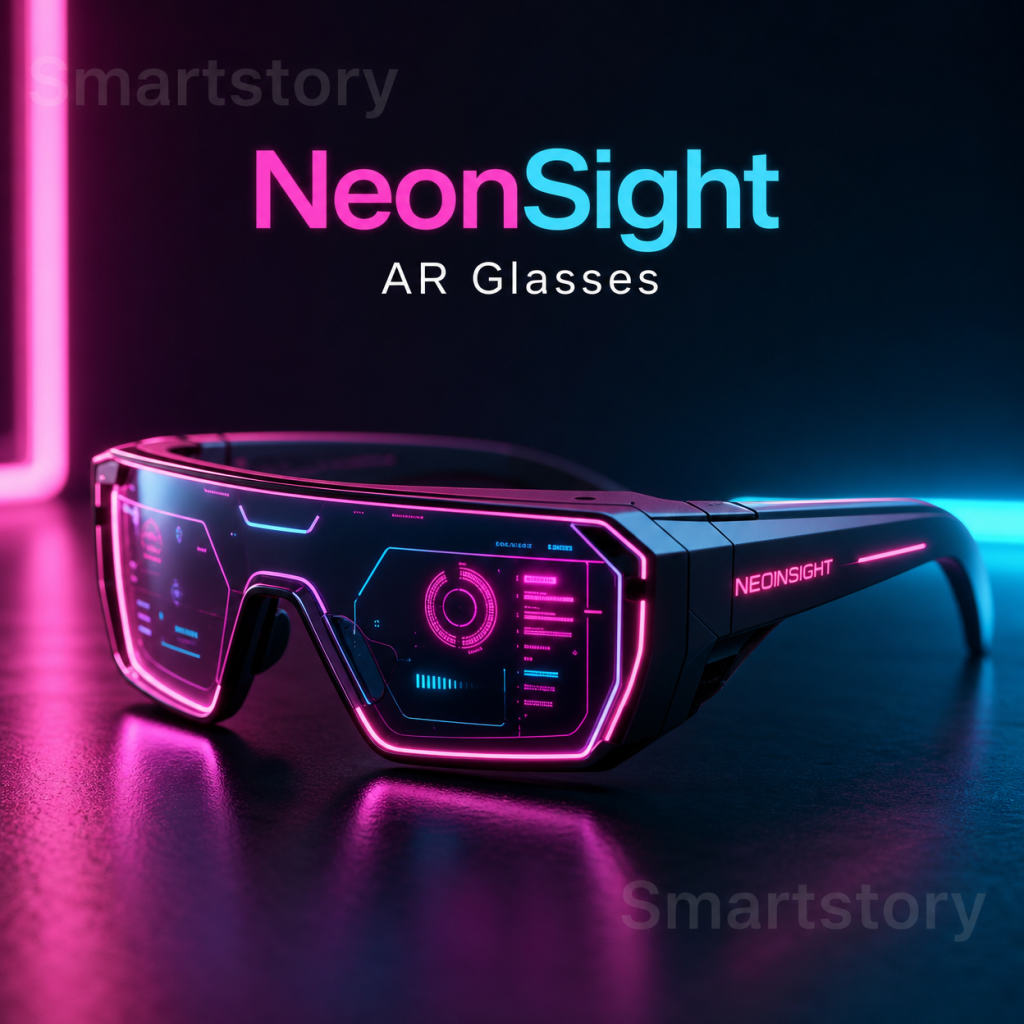
The frame features ultra-thin graphene-alloy construction reinforced with illuminated neural conduits and reactive holographic lens coatings that subtly shift color depending on environmental lighting and user activity.
Several futuristic AR-glasses concepts online already showcase similar aesthetics involving glowing interface reflections, transparent holographic displays, and neon-lit cybernetic fashion. (artstation.com)
The NeonSight expands those ideas into a fully immersive wearable interface system.
The transparent lenses glow faintly with shifting blue-violet interface projections while biometric sensors embedded along the temples pulse dynamically according to neural activity and environmental interaction.
At night, the visual effect becomes especially striking.
The glasses appear less like consumer electronics and more like advanced cybernetic augmentation worn by elite operatives inside futuristic megacities.
Adaptive Augmented Reality Projection
The defining feature of the NeonSight AR Glasses is their fictionalized adaptive holographic projection engine.
Instead of relying on fixed displays, the system supposedly projects fully dynamic holographic overlays directly into the user’s visual environment.
Within the fictionalized NeonSight ecosystem, users can supposedly interact with:
- Floating productivity dashboards
- Real-time translation systems
- AI-generated recommendations
- Tactical navigation overlays
- Environmental diagnostics
- Facial-recognition systems
- Smart-city infrastructure data
- Immersive gaming environments
Modern augmented reality systems increasingly explore spatial-computing environments capable of integrating digital interfaces directly into physical space. (apple.com)
The NeonSight imagines these technologies evolving dramatically further.
The holographic overlays feel fluid, reactive, and nearly indistinguishable from physical reality.
The user no longer simply views digital information.
They exist inside it.
AI-Assisted Cognitive Interface
One of the most advanced aspects of the NeonSight AR Glasses is their integrated AI system known as NEON Cognitive Intelligence.
Rather than functioning like a standard digital assistant, the AI continuously analyzes user behavior, environmental conditions, and cognitive focus patterns in real time.
The system monitors:
- Eye movement
- Focus intensity
- Emotional fluctuations
- Environmental hazards
- Behavioral tendencies
- Information overload levels
- Stress indicators
- Spatial awareness patterns
Based on this analysis, the AI dynamically adapts the augmented reality environment.
For example:
- Navigation overlays simplify during stress conditions
- Important notifications prioritize automatically during emergencies
- AI-generated summaries appear during information overload
- Environmental dangers receive visual threat highlighting
- Productivity interfaces reorganize according to cognitive fatigue
The AI feels less like software and more like an intelligent extension of the user’s own perception.
This creates an atmosphere where human cognition and machine intelligence operate together seamlessly.
Real-Time Smart-City Integration
The NeonSight AR Glasses feel perfectly designed for futuristic cyberpunk megacities.
Cyberpunk fiction frequently portrays urban environments saturated with holographic advertising, AI-driven navigation systems, and augmented-reality infrastructure. (cyberpunkcentral.com)
Within the fictionalized NeonSight ecosystem, the glasses synchronize directly with smart-city systems to provide:
- Real-time transit updates
- Environmental hazard warnings
- Building diagnostics
- Crowd-density mapping
- AI-driven navigation routes
- Security alerts
- Interactive holographic advertisements
The result feels astonishingly immersive.
The city itself becomes interactive.
Physical architecture and digital infrastructure merge into a single continuously evolving information network.
Neural-Responsive Interaction Systems
One particularly fascinating aspect of the NeonSight AR Glasses is their fictionalized neural-responsive interface system.
Instead of relying solely on touch controls or voice commands, the glasses supposedly interpret subtle neurological and ocular activity patterns.
Cyberpunk fiction has long imagined wearable interfaces capable of responding almost instantly to cognitive intent. (reddit.com)
Within the NeonSight ecosystem, users can supposedly:
- Navigate menus through eye movement
- Trigger applications using neural focus patterns
- Manipulate holograms through gesture tracking
- Prioritize information subconsciously
- Control drones through augmented interfaces
The interaction feels incredibly fluid.
The user no longer manually controls technology.
Technology responds intuitively to thought and attention.
Gaming and Entertainment Applications
The NeonSight becomes especially impressive inside gaming and entertainment environments.
The glasses transform ordinary surroundings into immersive mixed-reality experiences layered directly onto physical reality.
Within the fictionalized ecosystem, users can supposedly:
- Experience holographic multiplayer gaming
- Interact with AI-generated characters
- Transform cities into tactical battle arenas
- Synchronize neural focus with gameplay systems
- Experience dynamic environmental storytelling
The experience feels remarkably similar to augmented-reality systems portrayed in cyberpunk anime and futuristic science-fiction films.
The line between digital entertainment and physical reality becomes increasingly blurred.
Biometric Synchronization and Health Monitoring
The NeonSight AR Glasses also incorporate advanced biometric monitoring systems.
Micro-sensors embedded throughout the frame continuously analyze:
- Heart rate
- Eye strain
- Stress levels
- Fatigue indicators
- Neural activity patterns
- Emotional fluctuations
The AI uses this data to optimize visual presentation, reduce cognitive overload, and improve user comfort.
For example:
- Brightness adjusts automatically according to fatigue
- Blue-light filtering activates dynamically
- Environmental overlays simplify during stress
- Focus-enhancement modes activate during productivity sessions
The glasses behave less like wearable displays and more like adaptive cognitive-assistance systems.
Holographic Communication Systems
One of the most visually stunning aspects of the NeonSight AR Glasses is their holographic communication architecture.
Instead of conventional video calls, the system projects fully spatial holographic avatars directly into the user’s physical environment.
Cyberpunk fiction frequently portrays holographic communication as a standard feature of futuristic societies. (fandom.com)
Within the NeonSight ecosystem, this allows users to experience:
- Real-time holographic meetings
- Immersive virtual collaboration
- AI-generated interactive assistants
- Spatial communication environments
The visual experience feels cinematic and deeply futuristic.
Security and Cognitive Privacy
Because the NeonSight constantly analyzes user behavior and environmental data, privacy becomes critically important.
The glasses include fictionalized protections such as:
- Biometric identity locks
- Neural-pattern encryption
- AI intrusion detection
- Secure environmental scanning
- Adaptive privacy filtering
- Encrypted communication systems
Modern discussions surrounding AR ecosystems increasingly explore concerns involving surveillance, behavioral tracking, and digital privacy. (eff.org)
Cyberpunk fiction has long portrayed augmented-reality systems as both empowering and dangerously invasive.
The NeonSight captures that tension perfectly.
The Cyberpunk Atmosphere
What truly makes the NeonSight AR Glasses compelling is the atmosphere they create.
The glowing holographic overlays, AI-driven perception systems, smart-city synchronization, and neural-responsive interfaces create a world where digital information saturates everyday reality.
Cyberpunk fiction has always explored societies where technology becomes inseparable from human perception itself. (cyberpunkcentral.com)
The NeonSight embodies that philosophy beautifully.
The user no longer merely views the digital world.
They live inside it continuously.
Ethical and Existential Questions
Despite its extraordinary capabilities, the NeonSight AR Glasses raise major ethical concerns.
Questions quickly emerge surrounding:
- Constant surveillance
- Behavioral tracking
- AI-driven perception manipulation
- Digital addiction
- Corporate control of augmented reality
- Loss of unfiltered reality
- Information overload
- Cognitive dependency on AI systems
The glasses represent the central cyberpunk dilemma perfectly:
Technology enhances perception while simultaneously threatening autonomy and privacy.
Final Verdict
The NeonSight AR Glasses represent one of the most visually immersive and technologically fascinating visions of future augmented-reality technology imaginable.
They successfully combine cyberpunk aesthetics, adaptive holographic projection, AI-assisted cognition, neural-responsive interaction, smart-city integration, and biometric synchronization into a device that feels remarkably believable.
More importantly, they reflect how rapidly modern augmented-reality systems, wearable AI platforms, and spatial-computing technologies are approaching ideas once considered purely science fiction. (apple.com)
The NeonSight is not simply about displaying information more efficiently.
It is about transforming human perception itself into part of the digital ecosystem.
And if augmented-reality technology continues evolving toward seamless cognitive integration, the cyberpunk future imagined for decades may arrive far sooner than anyone expected.
